Beyond Digital Transformation: How Enterprises Can Scale Digital Impact in 2026
In early 2025, enterprises were still grappling with the realities of digital transformation. The focus was on overcoming fragmented systems, talent gaps, and the challenge of turning digital strategy into execution. In our earlier blog, Top Digital Transformation Challenges and How to Overcome Them in 2025, we explored the constraints holding organizations back and the steps needed to move forward.
As we enter 2026, the conversation has evolved. For many enterprises, digital transformation is no longer the primary challenge – scaling its impact is. The question leaders are now asking is more direct: How do we turn these efforts into sustained, enterprise-wide value?
This shift marks a critical turning point. 2026 is not about doing more digital transformation. It is about moving beyond it, which includes aligning digital capabilities with business outcomes and scaling these efforts in a way that is measurable, repeatable and profitable.
Over the last few years, most enterprises have made significant progress on their digital transformation agendas. The technology foundation is already in place. Yet, the impact often remains uneven. Digital initiatives deliver value in siloes rather than across the enterprise. Pilot programs succeed but fail to scale.
The gap lies in how transformation is approached. Digital transformation has often been treated as a bunch of technology-led initiatives rather than a fundamental shift in operating models, decision-making, and execution. As a result, the translation of digital capabilities into sustained business outcomes is lost.
In 2026, bridging this gap becomes critical. Enterprises can no longer measure success by the number of systems modernized or tools deployed. The focus must shift to outcomes such as productivity gains, faster time-to-market, and better customer experiences.
Digital transformation initiatives have laid the foundation. Now, the real differentiator will be how effectively enterprises scale that foundation into consistent, enterprise-wide impact.
Traditional ITSM models were built for stability, not for scale. Service management must now move beyond reactive ticket resolution and become a proactive capability. This means anticipating issues before they disrupt work.
This evolution requires tighter integration between ITSM platforms, monitoring tools, and DevOps ecosystems to create real-time visibility into service health. AI-driven automation can enable predictive incident management and faster resolution. As a result, modern ITSM can become a backbone for enterprise-wide workflow automation, extending its value far beyond IT operations and directly supporting business productivity.
To know more, discover how we transformed the ITSM process for a major FMCG organization with a strategic ServiceNow implementation.
AI adoption has accelerated, but in many organizations it remains fragmented. Isolated use cases and experimentation limit enterprise-wide impact. Meaningful digital impact will only come from embedding AI directly into core business and IT workflows rather than treating it as a standalone initiative.
Enterprises should start with strengthening data foundations through unified data platforms and real-time data pipelines. AI capabilities must be seamlessly integrated into areas such as software engineering, IT operations, customer engagement, and decision intelligence, supported by governance frameworks that address security and regulatory compliance.
Curious about AI adoption at scale? Unlock the full potential of AI with our comprehensive AI Strategy and Governance solutions.
Many digital initiatives struggle because the underlying systems cannot keep up. Legacy platforms create friction, slow decision-making, and increase operational complexity. To scale digital impact, enterprises need technology foundations that are built for growth.
In 2026, modernization is less about replacing systems and more about enabling adaptability. For instance, cloud-native platforms built on microservices, containers, and API-led integration can allow systems to evolve incrementally. The result is an enterprise platform that is built to adapt!
As digital ecosystems expand, so does risk. Cybersecurity and governance can no longer be reactive controls applied at the end of delivery cycles. They must be integrated from the start.
This includes strengthening defenses against network intrusion, building secure-by-design applications, continuously monitoring cyber threats, and proactive risk management embedded into delivery pipelines. When cybersecurity is integrated across platforms, processes, and workflows, organizations can reduce disruption and enable sustainable digital growth. Consequently, when built by design, security becomes an enabler of scale.
To dive deeper, tune in to our webinar, Cyber Program Operations: What might be missing from your Cyber Strategy, and explore key gaps in today’s cyber strategies.
Technology alone does not create impact. Execution does. Enterprises that align people, platforms, and operations around clear priorities will move faster and with greater confidence. The goal is not transformation for its own sake, but sustained progress that the business experiences every day.
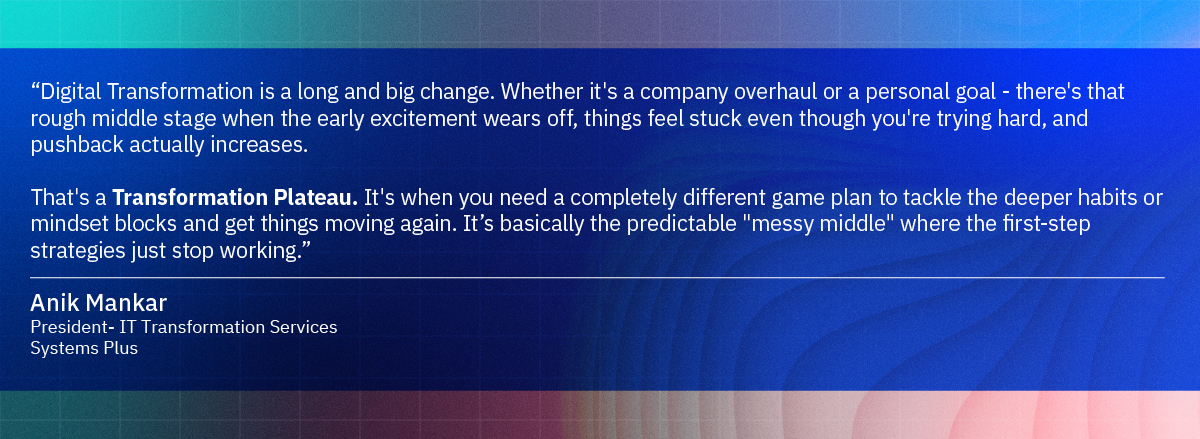
In the words of Anik Mankar, President of IT Transformation Services at Systems Plus, “When transformation slows despite effort, it’s time to change the strategy, not push harder. A transformation plateau isn’t failure. It’s a signal to rethink how change is driven.”
If you are looking to scale digital impact in a way that is practical, outcome-driven, and aligned with your enterprise goals, connect with our experts to explore what’s next.


 Systems Plus Recognized Among India’s Top 50 Best...
  6 GCC Case Studies: Real-World Examples of How...
  The Great GCC Carve-out: A Systems Plus POV
  Why Business Continuity Planning is Critical for Modern...
  Systems Plus Recognized Among India’s Top 100 Great...