The Great GCC Carve-out: A Systems Plus POV

By every measure that matters, FY2026 was the strongest year India’s Global Capability Center (GCC) ecosystem has ever recorded: 2,117 centers, $98.4 billion in revenue, 2.36 million professionals, per the NASSCOM GCC Landscape Report 2026. It was also the year Guardian Life and Olam — which between them had put more than fifty years into two of the most mature captives in the country, made a decision to sell.
Neither was in distress. Both had reached the point most centers eventually reach, where the honest question is whether running a technology organization is the best use of the company’s capital and attention. For both, the answer was no. They will not be the last — boards across industries quietly asking the same question about their own centers, and the ones asking it first get to answer on their own terms.
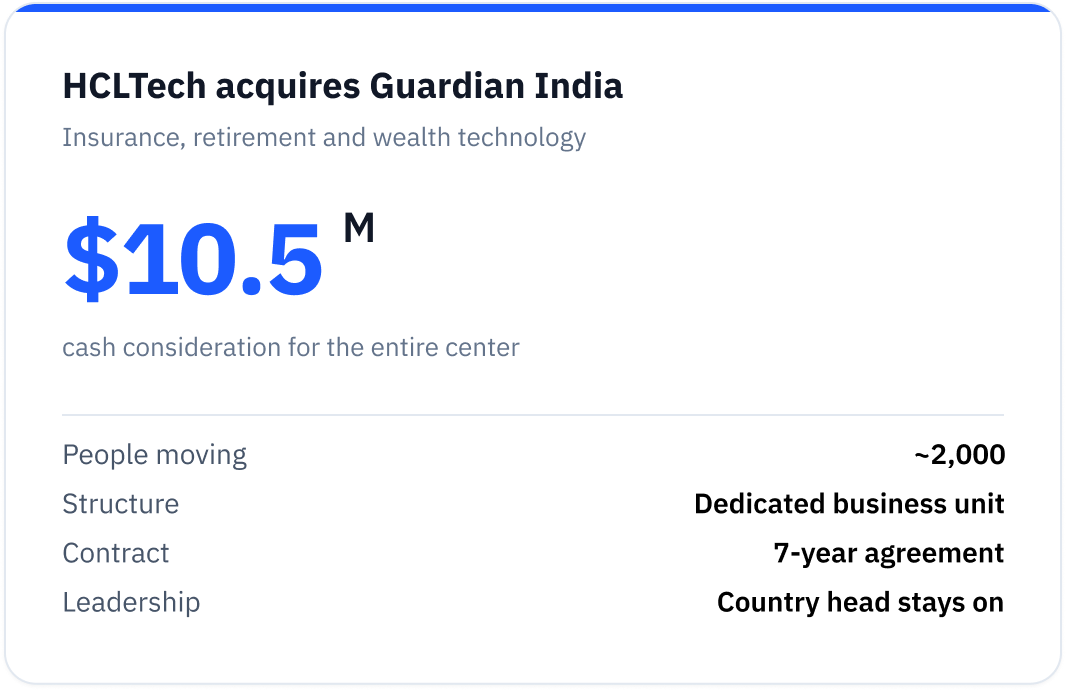
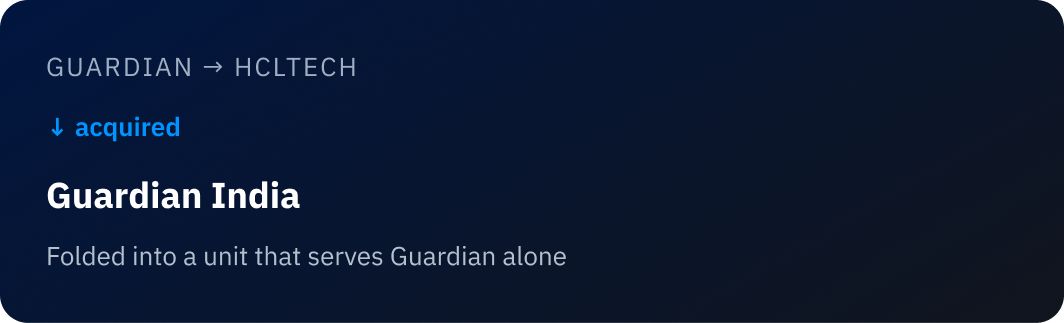
In July 2026, HCLTech announced a seven-year strategic agreement with The Guardian Life Insurance Company of America and, as part of it, the acquisition of 100% of Guardian India Operations Private Limited — the insurer’s technology and operations GCC, for $10.5 million, per its regulatory filing. Nearly 2,000 engineers and operations specialists across Chennai and Gurugram move into a dedicated Strategic Business Unit within HCLTech, with Guardian India’s country head crossing over to lead it. The center was incorporated in 2002; Guardian ran it for close to a quarter of a century.
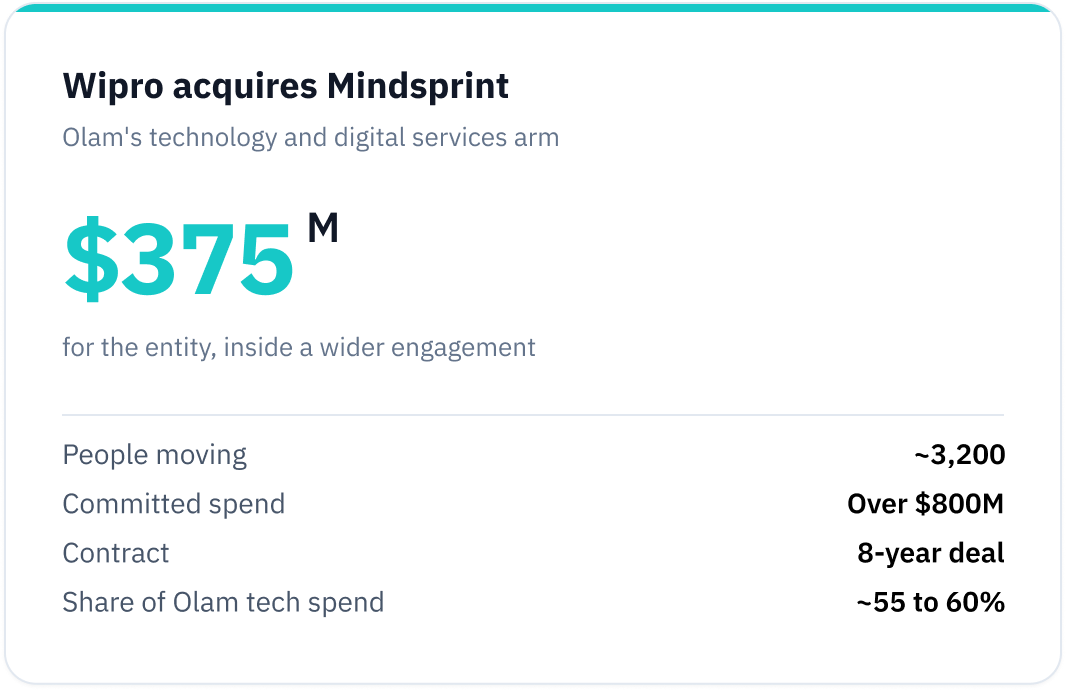
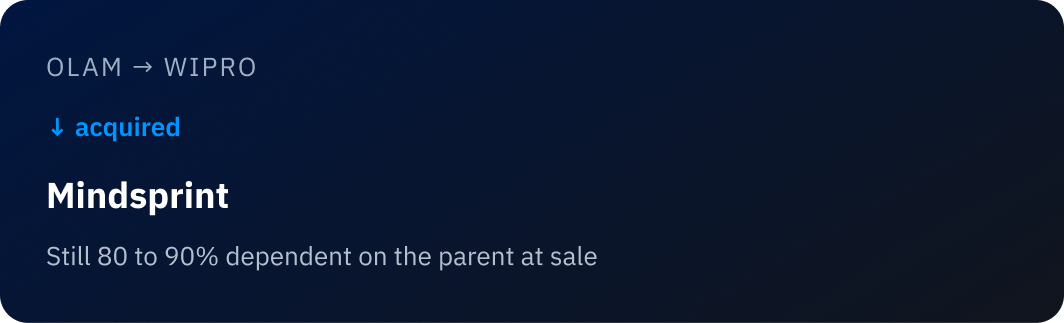
Three months earlier, Wipro agreed to acquire Mindsprint, the entity that began as Olam’s technology and business services arm and served as the agri-business major’s GCC for nearly three decades, at an enterprise value of $375 million, completing the deal in May 2026. The acquisition sits inside an eight-year transformation engagement expected to exceed $1 billion in contract value, with $800 million in committed spend, and brings roughly 3,200 professionals plus a portfolio of proprietary agri-tech platforms.
Different industries — a Fortune 250 US mutual insurer, a Singapore-headquartered food and agricultural giant. Identical architecture: sell the entity, sign a long-term agreement, keep the capability.
Put the two price tags side by side and something unusual appears. Guardian India billed about $67 million (₹578.8 crore) in FY26, meaning a 2,000-person operation changed hands for roughly 0.15 times its annual billings. Mindsprint, meanwhile, went for about 2.8 times revenue, by Everest Group’s estimate, even though 80–90% of that revenue still came from Olam.
The gap is the lesson. An offshore center’s billings are intercompany, cost-plus arrangements rather than market revenue, so the entity itself carries almost no standalone value, which is precisely the point. What the buyer is really buying is the contracted future. Guardian’s value moved through the seven-year services agreement attached to the sale; Mindsprint’s multiple priced an $800 million committed spend and a set of platforms with life beyond one parent. In both cases, the entity was the shell. The value lived in the relationship and the intellectual property attached to it.
Anyone weighing a GCC should sit with that arithmetic before hiring the first employee, not after the tenth year.

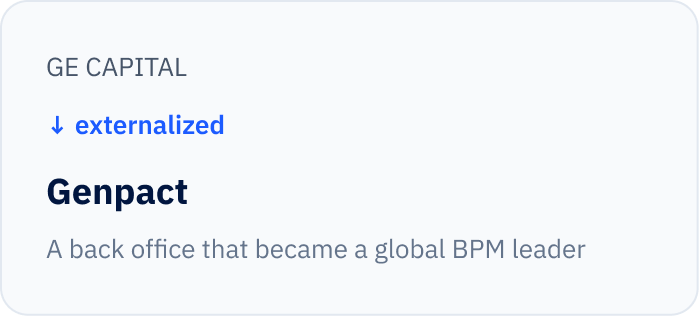
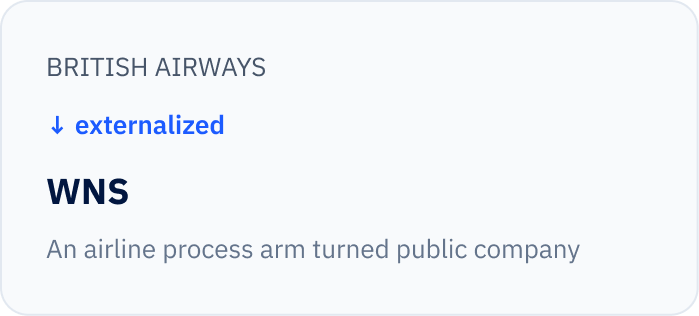
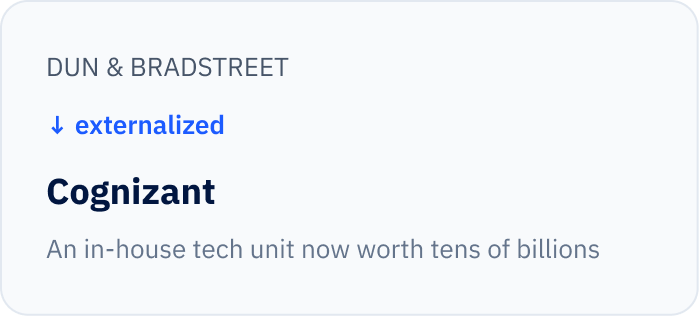
The largest names in technology services began as offshore centers that a parent chose to release. Genpact was GE Capital’s back office. WNS came out of British Airways. Cognizant started inside Dun & Bradstreet. Each began captive; each was carved out; each outgrew the parent that built it.
The pattern repeats in waves. In 2008, TCS acquired Citigroup Global Services for roughly $505 million alongside a $2.5 billion, 9.5-year services contract, and Cognizant, Wipro, and Infosys absorbed captive units of UBS, Citi, and ABN Amro in the years that followed; in 2020, Infosys paired a $454 million Danske Bank engagement with the takeover of the bank’s India IT center. Those deals were read as crisis responses. The 2026 carve-outs are different: deliberate portfolio choices made from strength. When the divestiture stops being a rescue and becomes a strategy, the market is telling us something about the operating model itself.
The arc is consistent enough to draw. A captive or offshore hub is built for control, talent, and cost. It scales. Then it plateaus: the cost gap narrows, the talent market turns brutal — every center now competes for AI and engineering skills against 2,116 other centers and 506 Forbes Global 2000 companies — the stack ages, and AI lifts the delivery bar faster than a single-client center can fund. At the plateau, the center faces a fork: pour fresh capital into modernizing a unit that was never the core business, or hand it to an operator who runs technology for a living.
The reason is always the same. Capability is essential to the business; it is not the business. Guardian sells insurance and manages retirement money. Olam trades and processes food. Technology is the engine room for both, and the engine room is rarely what a company wants to own forever.
Each stakeholder reads the same conclusion differently, and each reading holds: the CFO sees trapped capital and fixed cost converted into a contracted relationship; the CIO sees access to platforms and AI investment a 2,000-person captive could not fund alone; employees see broader career architecture inside a global technology firm; the board sees delivery risk shift to a partner contractually accountable for outcomes.

Here is the uncomfortable part: the sale that ends a GCC’s life is really a decision taken at birth, before a single person is hired. Who should own the center, and who should run it? Three models answer that question, and most companies reach for the first out of instinct rather than analysis.
Three ways to run a GCC
| Captive — you own and run it | Managed GCC — dedicated to you, run by an operator | Traditional outsourcing — a provider owns the work | |
| Control and direction | Full — you run everything | You set direction and governance; delivery is run for you | Limited — the provider decides how |
| IP and data | Inside your walls | Stays under your governance | Sits within the provider’s estate |
| Speed to stand up | Slow — built from zero | Fast — entity, site, and hiring are ready | Fast to start |
| Capital and management load | High — it is a second business to run | Light — the operator carries it | Lowest |
| AI and modernization | Your budget, your talent fight | The operator’s core business, at market pace | Provider-led, prioritized across many clients |
| Team and context | Dedicated, deep context | Dedicated, deep context | Pooled — context walks out with rotation |
| Long-term risk | You carry the wind-down, as Guardian did | The operator carries the weight | Low commitment — and low continuity |
The managed model keeps what companies build centers for — ownership of the outcome, governance of the IP and data, and a dedicated team that holds the company’s context and sheds the part that sends captives to market a decade later: the burden of running an operation that was never the point.
Guardian and Olam are not cautionary tales; they made sound decisions with mature assets. The signal is in what came before the sale. Three questions surface it.
If a captive’s likely endpoint is an operator’s balance sheet, there is little to no reason for the journey to pass through the arduous ownership phase at all. That is the model Systems Plus was built around: 30+ GCCs delivered over 38 years for global enterprises across retail, FMCG, logistics, and financial services, each a dedicated center that works as an extension of the client’s team, under their governance, with full visibility, and without the capital or operational weight of owning it.
The takeaway here is that ownership is a choice, and the companies that make it deliberately, at the start, keep control of both the timeline and the price. If a GCC is on your roadmap, or an existing one is due a fresh look, connect with our team today.

 The Pod-to-GCC Operating Model: How Offshore Pods Become...
  Systems Plus Recognized Among India’s Top 50 Best...
  6 GCC Case Studies: Real-World Examples of How...
  Why Business Continuity Planning is Critical for Modern...
  Systems Plus Recognized Among India’s Top 100 Great...